September 30, 2026 | AI4Science, global health and cross-border capital
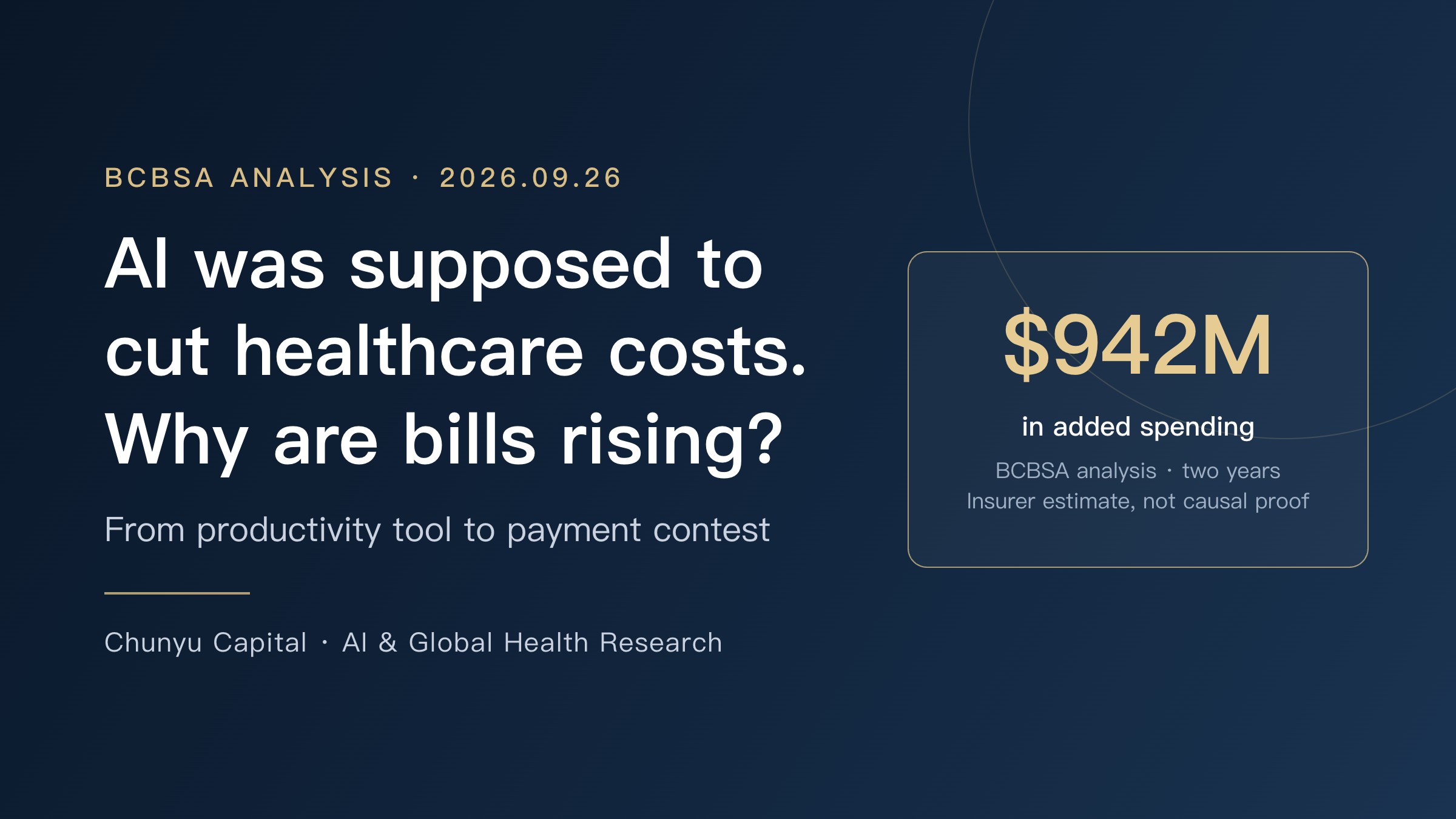
On September 26, TechCrunch reported that an analysis by the Blue Cross Blue Shield Association linked hospitals’ use of AI-assisted documentation and coding to approximately $942 million in additional healthcare spending over two years. The analysis observed a sharp increase in patients documented as having complex conditions without evidence of a corresponding change in care delivered. TechCrunch, September 26, 2026
This does not prove that AI caused every dollar of additional spending, nor does it establish that hospitals acted improperly. It does, however, expose a fundamental issue in healthcare AI:
When incentives remain unchanged, AI may automate the existing contest over payment before it improves the economics of care.
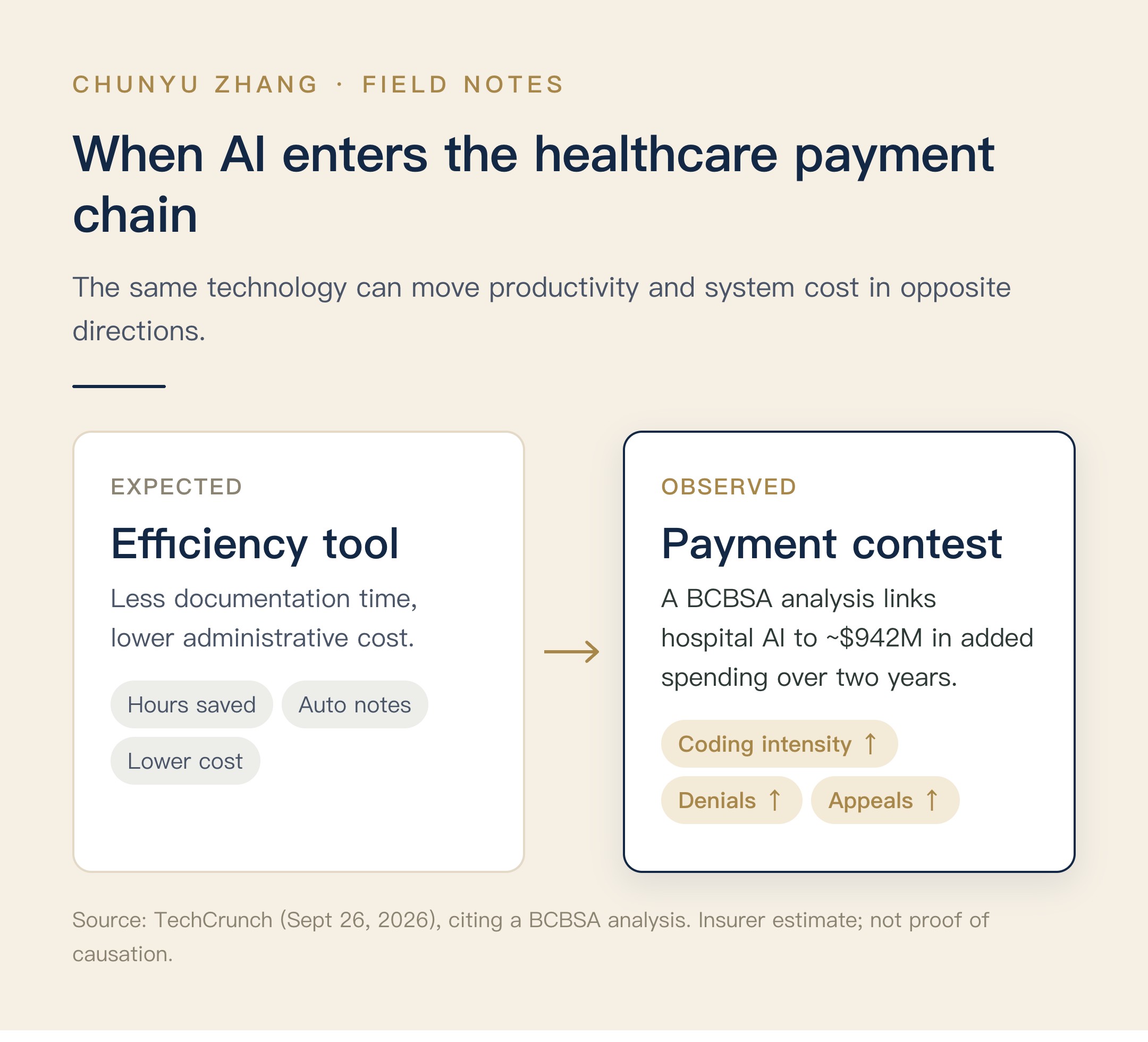
AI is entering both sides of the reimbursement system. Providers use it to produce more complete clinical notes, identify diagnoses and support claims. Insurers use it to review claims, challenge coding and manage prior authorization.
A Reuters investigation in March described the same dynamic and cited a different BCBSA estimate: more aggressive AI-enabled coding may be associated with roughly $663 million in inpatient spending and at least $1.67 billion in outpatient spending nationwide. Reuters, March 12, 2026
The figures come from different scopes and methodologies. They should not be added together or treated as causal proof. Their shared signal is more important: generative AI is no longer only a clinical productivity tool. It is becoming part of the financial machinery of healthcare.
U.S. healthcare spending reached $5.3 trillion in 2024, or 18% of GDP. CMS projects health spending growth to continue outpacing economic growth through 2034. CMS
In a system this large, small changes in coding intensity can move enormous amounts of money. Each participant may be acting rationally: providers seek complete documentation and fair payment; insurers seek to prevent unnecessary spending. Yet individually rational optimization can produce a collectively inefficient result.
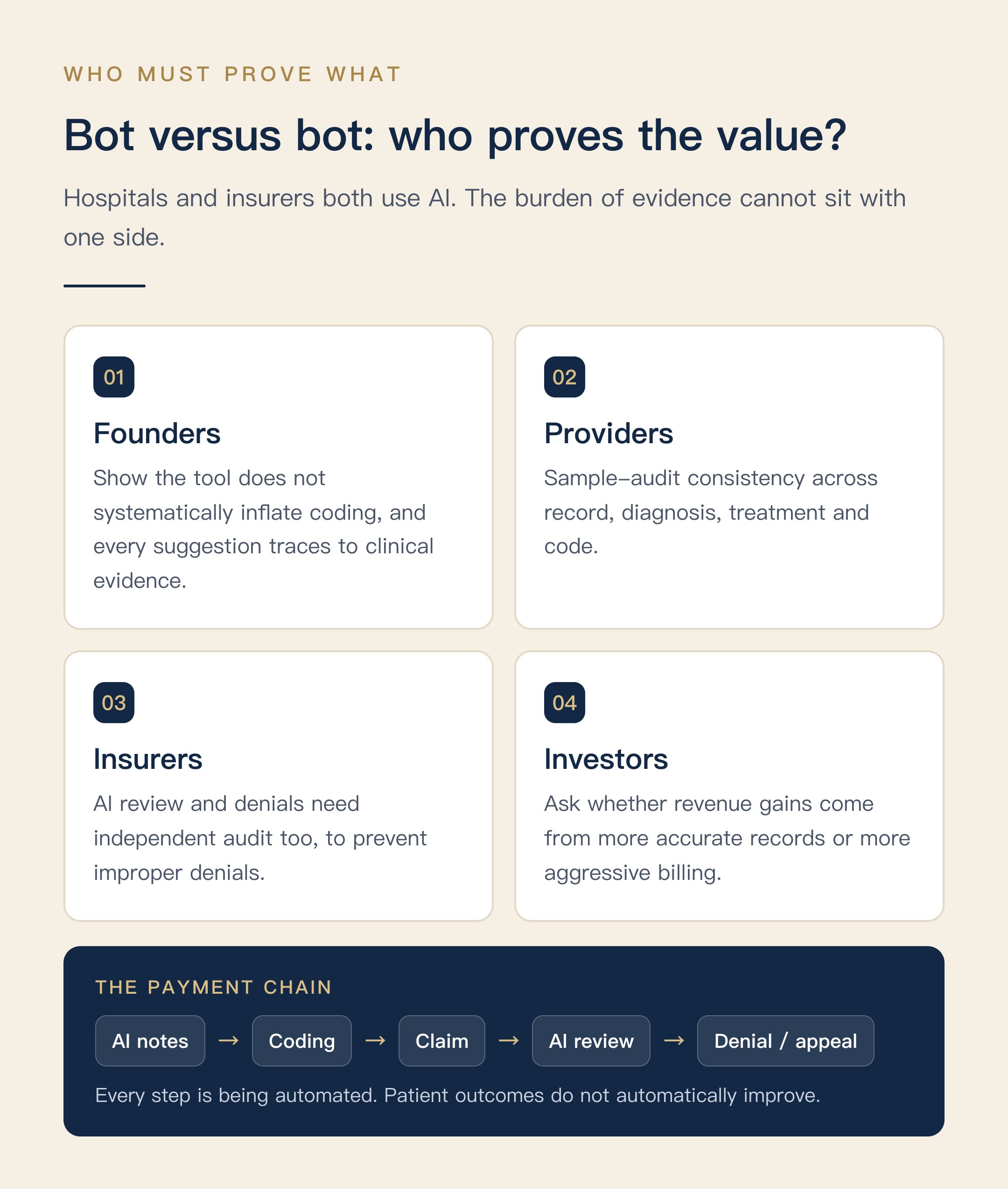
The worst case is a “bot-versus-bot” cycle. One system expands documentation and supports a higher-acuity code. Another challenges the claim. A third drafts the appeal. More tasks are automated, but the patient does not necessarily receive better care.
If AI only accelerates billing, denial and appeal, efficiency has not become social value. It has become faster administrative competition.
For founders, “saving clinicians two hours a day” is no longer enough. A credible product must also show that it does not systematically inflate coding, trigger unnecessary care or create downstream compliance costs. Every high-risk recommendation should be traceable to clinical evidence.
For healthcare organizations, AI-generated documentation should not automatically become a bill. Leaders need sample-based review of the consistency among the medical record, diagnosis, treatment and code. Coding shifts, denial rates and appeal rates should be monitored as model-quality indicators.
For investors, rapid revenue growth does not necessarily prove system value. Ask whether customer gains come from more accurate documentation or more aggressive reimbursement. Ask whether labor savings are offset by denials, audits, disputes and compliance expense.
After nearly two decades in healthcare investing, I have learned that local productivity is easy to demonstrate; system-level value is much harder.
A tool may help a physician finish notes faster. It may increase hospital collections. It may help an insurer reduce payments. None of those outcomes alone proves that patients received better care at a lower total cost.
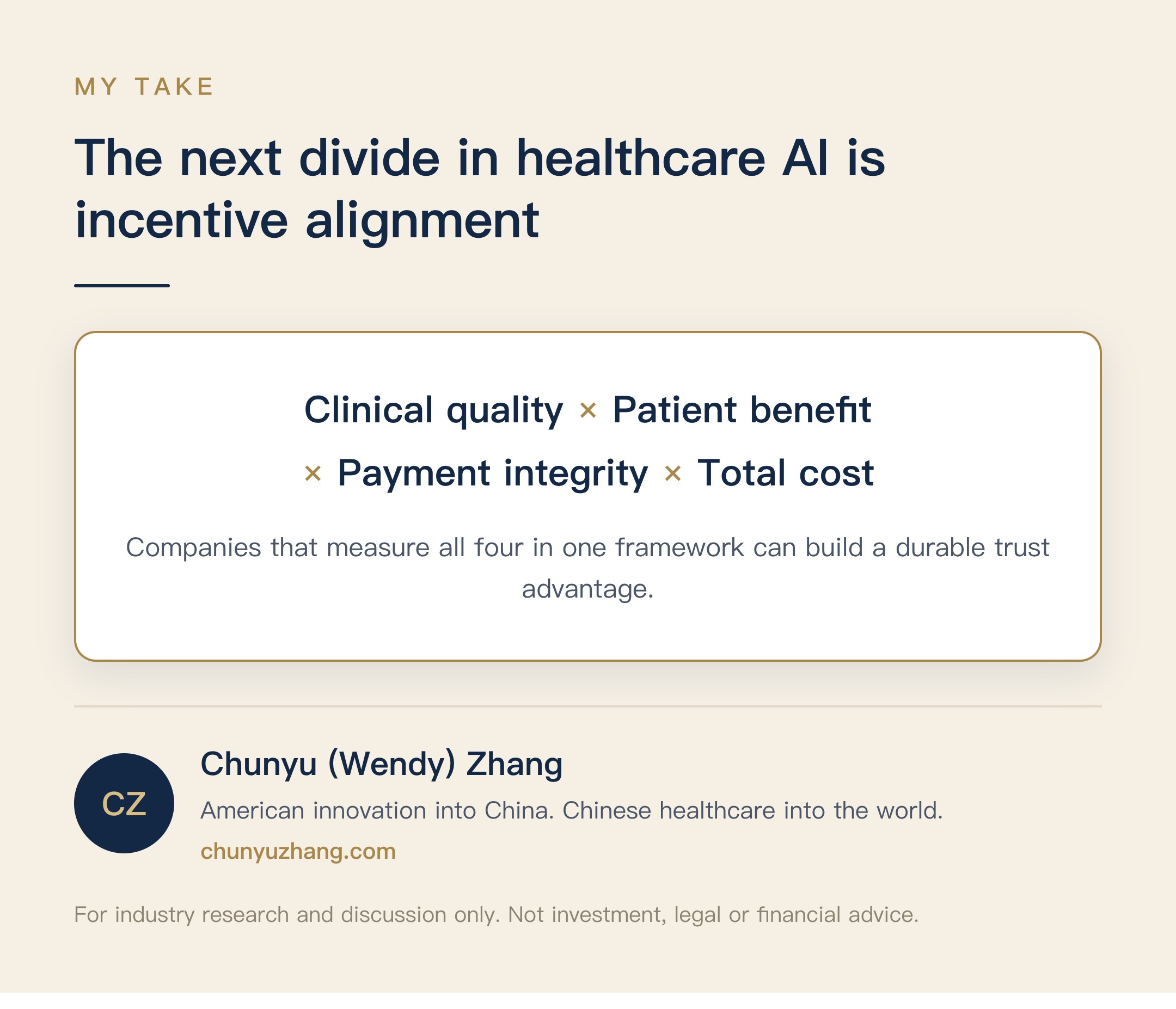
The strongest healthcare AI companies will need to show a broader evidence trail: Was the record more complete? Was the diagnosis more accurate? Did the patient receive the right care sooner? Did total cost fall? When the system was wrong, who detected and corrected it?
My view is that the next divide in healthcare AI will not be model performance alone. It will be incentive alignment. Companies that connect clinical quality, patient benefit and payment integrity in one measurable framework may build a far more durable trust advantage than those optimizing only one side of the transaction.
Hospitals can reasonably argue that AI captures conditions that were previously under-documented. Inpatient populations may also look more complex because lower-acuity care has shifted to outpatient settings. The insurer-sponsored analysis reflects the insurer perspective and observational data cannot establish causality by itself.
Insurer AI deserves equal scrutiny. HHS-OIG has previously found that some prior-authorization requests meeting Medicare coverage rules were still denied. Cost control can also create patient harm if it is not independently audited. HHS-OIG
The right conclusion is not to stop healthcare AI. It is to require every participant to answer the same questions: What improved? What new cost appeared? Who absorbed the risk?
For industry research and discussion only. This is not medical, legal or personal investment advice.
CHUNYU CAPITAL AI
A cross-border healthcare investor with nearly 20 years of healthcare investment and industry experience, focused on medical devices, innovative drugs, AI4Science and cross-border capital markets. She works to connect the U.S. and Asian markets, helping healthcare and technology companies understand industry trends, financing pathways and global opportunities. Stanford GSB alumna.
A research and industry-connection platform focused on global healthcare, AI4Science and cross-border capital. Grounded in public facts, primary sources and a long-term industry perspective, it studies technology commercialization, corporate financing and capital-market pathways, offering founders, executives and investors independent, clear and actionable decision support.